

Why would you settle for a ring that thousands of other people are wearing right now? It's a common struggle; you want a piece of jewelry that feels personal, but the rows of identical bands at the mall leave you feeling underwhelmed. You aren't alone if you've felt disappointed by the lack of character in modern, mass-produced pieces. Finding the perfect balance of quality and personality often feels like a chore, especially when you're worried about overpaying for something that lacks a soul. That's exactly why vintage rings have become the ultimate secret for savvy shoppers. By choosing a piece made between 1926 and 2006, you're stepping away from the assembly line and into a world of genuine artistry.
Think of this as your insider guide to finding a high-quality treasure at a price that makes sense. We'll show you how these hand-crafted survivors offer superior craftsmanship and a unique history that modern jewelry simply can't touch. You'll learn how to search with confidence, moving past the confusing jargon to find a ring that makes you feel like a savvy insider. From the unique fire of an Old European cut diamond to the intricate hand-engraving of the Art Deco era, get ready to discover why your next favorite piece of jewelry is already out there waiting to be found.
Key Takeaways
- Learn the 100-year rule to distinguish between antique and vintage pieces so you can shop like a pro.
- Discover why hand-forged craftsmanship and intricate filigree details offer a level of quality that modern mass-produced bands can't match.
- See how choosing vintage rings allows you to avoid the retail markup and own a sustainable, one-of-a-kind piece of history.
- Master the art of reading hallmarks and identifying era styles to ensure you're getting a genuine, high-quality find.
- Find out how a vetted, curated collection makes it easy to secure a unique treasure with total peace of mind.
Defining the Magic: What Exactly Makes a Ring "Vintage"?
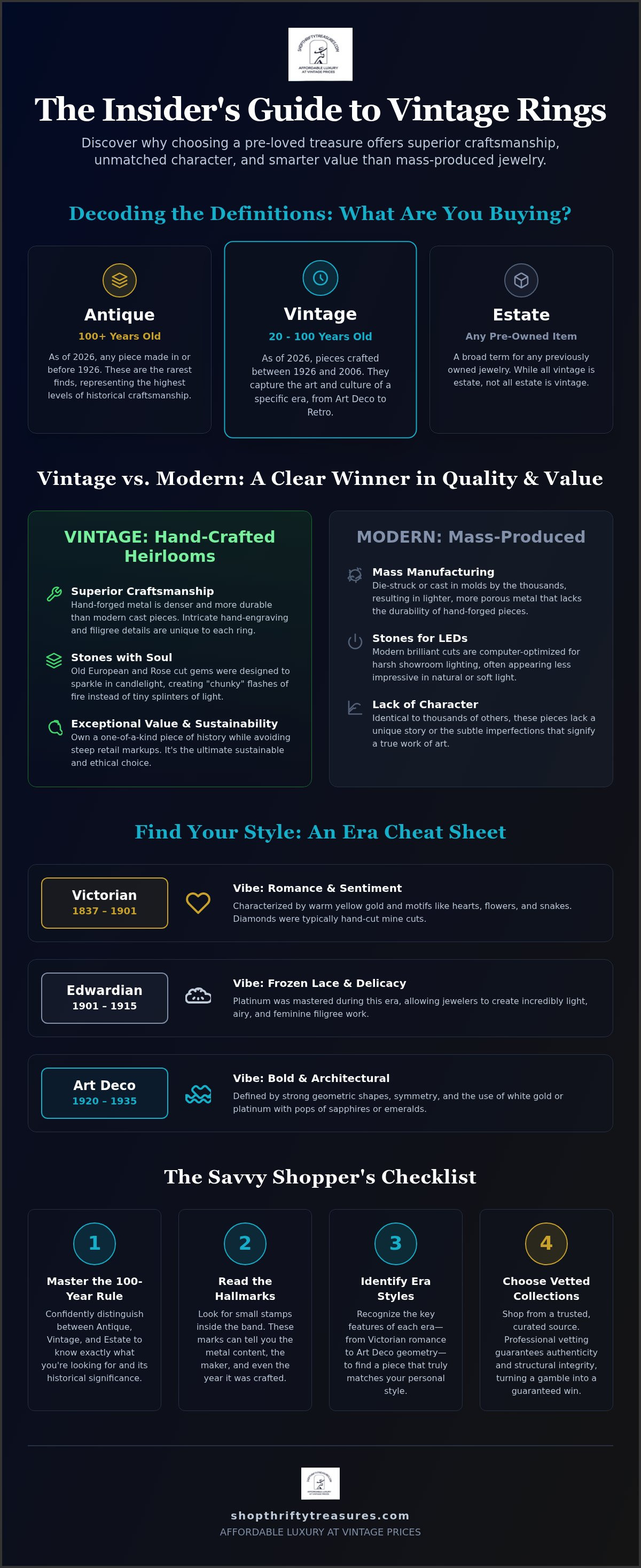
Ever wonder if that beautiful piece you spotted is truly vintage or just "old"? In the jewelry world, we use the "100-Year Rule" to keep things clear and honest. As of 2026, vintage rings are those crafted between 1926 and 2006. Anything made in or before 1926 officially earns the prestigious title of "antique." This distinction isn't just a label; it's a window into the specific techniques and materials that define a generation.
You'll often see the word "estate" used alongside these terms. Think of "estate" as a broad umbrella. It simply means the piece was previously owned. While every vintage find is technically an estate piece, not every estate piece is vintage. A ring bought at a mall last year and sold today is "estate," but it lacks the historical soul and craftsmanship we're hunting for. The real magic happens when you find a piece that has lived through decades of history.
The history of rings shows us how societal shifts changed everything from the cut of a diamond to the choice of metal. Each era had its own personality. When you buy vintage, you're getting a "pre-loved" survivor that has a story to tell. These pieces weren't just manufactured; they were designed to reflect the art and culture of their time. It's the difference between owning a mass-market product and a piece of wearable art.
The Era Cheat Sheet: From Victorian to Retro
Each time period offers a different vibe for your personal style. Use this quick guide to narrow down your search:
- Victorian (1837-1901): These rings are all about romance and sentiment. Expect warm yellow gold, hand-cut mine diamonds, and motifs like snakes, hearts, or flowers.
- Edwardian (1901-1915): This era feels like wearing frozen lace. Jewelers mastered platinum during this time to create incredibly delicate, feminine filigree work.
- Art Deco (1920-1935): If you love bold, architectural vibes, this is your era. Look for geometric shapes, white gold or platinum, and vibrant pops of emeralds or sapphires.
Why "Vetted" is the Most Important Word in Your Search
Finding a random ring at a thrift store can be a fun gamble, but shopping a curated boutique is a strategic move. Professional vetting is the difference between a lucky guess and a guaranteed win. It ensures your vintage rings aren't modern reproductions made to look old. Experts check for era-appropriate hallmarks, stone cuts, and wear patterns that tell the true age of a piece. Vetted vintage is a guarantee of authenticity and structural integrity.
The Art of the Past: Why Antique Craftsmanship is Unbeatable
Have you ever noticed how a modern ring from a big-box store feels light, almost like plastic? That's because most modern jewelry is die-struck or cast in mass quantities. In contrast, vintage rings often feel more substantial and "alive" on your finger. This is because many were hand-forged. Jewelers would hammer and pull the metal, which actually makes it denser and more durable than the porous metal found in modern molds. If a piece has already survived eighty years of daily wear, it's a safe bet that it's built to last another eighty.
The human touch is what truly separates these treasures from the rest. Hand-engraving isn't just a pattern; it's a record of a master jeweler's steady hand. You can see the slight, beautiful variations in every leaf or scroll. Modern machines try to mimic this, but they often produce a "stamped" look that lacks depth. When you choose a vintage piece, you're wearing something that no one else has, because no two hand-carved bands are exactly identical.
Stones Cut for Candlelight: The Beauty of Old Cuts
Modern diamonds are cut for maximum "brilliance" under harsh showroom LEDs, but older stones were designed for a different world. Old European and Rose cuts were crafted to sparkle in the soft glow of candlelight. They have fewer, larger facets that create a "chunky" flash of light rather than the tiny, splintered sparkles of a modern brilliant cut. These hand-cut gemstones have a soul. You might find tiny imperfections or slightly asymmetrical shapes, but these aren't flaws. They're proof that a person, not a computer, shaped that stone to bring out its unique fire.
The "Lace in Metal" Phenomenon
During the Edwardian and Art Deco eras, jewelers achieved levels of detail that still baffle people today. They used a technique called filigree, which involves twisting and soldering fine threads of precious metal into intricate patterns. It looks like lace made of gold or platinum. While modern Computer-Aided Design (CAD) can create complex shapes, it often looks "flat" and clinical. Hand-carved vintage pieces have three-dimensional undercuts and tiny, crisp details that machines just can't replicate. If you want to see this artistry in person, you can browse our curated collection of unique finds to see the difference for yourself.
Vintage vs. Modern: A Comparison of Sustainability and Value
Choosing between a brand-new band and a storied treasure often comes down to one question: where does your money actually go? When you buy vintage rings, you aren't paying for a massive corporate marketing budget or high mall rents. Instead, you're investing in the tangible value of precious metals, rare gemstones, and hours of artisan labor. This makes the estate market a goldmine for the savvy shopper who wants more "ring" for their dollar without sacrificing quality or beauty.
Ethical peace of mind is another huge win for the vintage path. The global sustainable jewelry market has climbed to a value of approximately USD 75.55 billion in 2026, reflecting a massive shift in how we shop. By choosing a piece that already exists, you're opting out of the environmental and labor concerns associated with new mining. There are no new holes in the ground and no new carbon emissions from heavy machinery. It's the ultimate form of recycling, allowing you to wear a stunning piece of history that aligns perfectly with your values.
Investment potential is where the "insider" feeling really kicks in. While mass-produced modern bands often struggle to maintain their resale price, unique vintage pieces tend to hold their value remarkably well. In fact, Art Deco style rings are seeing an annual appreciation of 15% to 20% as of 2026. You aren't just buying a piece of jewelry; you're securing a hand-crafted survivor that collectors actively hunt for.
The Hidden Cost of "New"
Walk into a traditional jewelry store, and you'll likely face an immediate "drive-off-the-lot" style depreciation. A brand-new ring can lose a significant chunk of its retail value the second it hits your finger. Buying smart means looking for "thrifty" opportunities where the initial retail markup has already vanished. A vintage ring is a "pre-funded" investment in craftsmanship where you pay for the actual worth of the piece rather than the store's overhead.
Sustainability as a Style Statement
While lab-grown stones are a popular modern alternative, they still require significant energy to produce in a factory. A vintage piece has a zero-carbon footprint because it's a survivor from a past era. When you choose one of these treasures, you're playing the role of the hero by saving a work of art from being melted down for its raw gold. It’s a way to let your personal style tell a story of preservation and respect for the past.
The Savvy Shopper’s Guide: How to Pick the Perfect Vintage Ring
Ready to turn your dream of owning a piece of history into a reality? Finding the right piece requires a bit of strategy, but it’s a rewarding mission that makes you feel like a true insider. Start by picking your "Era Style." If you love soft, romantic motifs and warm gold, look toward the Victorian era. If you prefer bold, architectural lines, a geometric Art Deco piece will likely be your perfect match. Choosing vintage rings is about finding a reflection of your own personality in the craftsmanship of the past.
Next, you’ll want to check the secret codes. Most high-quality pieces feature hallmarks that act as a pedigree. These tiny stamps tell you about the metal purity and often reveal the maker’s identity. While you’re looking, evaluate the condition for "honest wear." A few tiny surface scratches on a band from the 1940s show it was loved, but you should always check that the prongs are secure and the stones aren't chipped. It's about finding a balance between character and structural integrity.
Don't forget to match the ring to your daily life. If you’re active or work with your hands, look for harder stones like diamonds or sapphires. Softer gems like opals or pearls are stunning, but they might be better suited for occasional wear. Finally, trust your source. Shopping with a curated boutique that offers clear photos and detailed descriptions takes the guesswork out of the hunt. You can start your journey here by browsing our latest vetted finds.
Decoding Hallmarks and Metal Stamps
Those tiny marks inside the band are your best friends. A stamp that says "14K" or "18K" confirms the gold content, while "PLAT" indicates the piece is made of durable, high-value platinum. Finding a maker’s mark, a small symbol or initials, is like finding a signature on a painting. It adds to the ring’s history and can even increase its value over time. Understanding these codes is a great way to verify the authenticity of vintage rings before you commit to a purchase.
Sizing and Maintenance for One-of-a-Kind Pieces
Can you size a vintage find? Usually, the answer is yes. Most simple bands can be adjusted by a skilled professional. However, be cautious with eternity bands or rings with intricate filigree that wraps all the way around, as sizing these can sometimes disrupt the pattern. To keep your treasure sparkling, avoid harsh chemicals and stick to mild soap and a soft brush. Since buying online can feel a bit daunting, we offer a 30-day return policy for peace of mind. This ensures you can see the piece in person and make sure it’s the perfect fit for your collection.
Start Your Treasure Hunt: Why Shop Thrifty Treasures is Your Next Stop
You've done the research and learned what makes these historical pieces so special. Now, it's time to find your own. At Shop Thrifty Treasures, our mission is simple: we want to connect savvy shoppers like you with high-quality, vetted vintage rings that actually tell a story. We don't just stock items; we curate them. Every piece in our collection is hand-selected for its beauty, structural integrity, and incredible value. We believe that owning a piece of history shouldn't be a gamble or a high-pressure experience.
We've built our boutique to feel like a trusted friend is guiding you through a hidden treasure chest. Because we operate entirely online, we bring the boutique experience directly to your doorstep with reliable national shipping across the US. You don't have to live in a big city to access world-class estate jewelry. We handle the vetting process so you can focus on the fun part: finding the ring that speaks to your soul.
Buying jewelry online can feel a bit risky, but we've removed the worry from the process. Our 30-day return policy is designed to give you total peace of mind. If the ring doesn't look quite right on your finger or the sparkle isn't what you imagined, you can send it back. It's a risk-free way to discover a one-of-a-kind piece that you'll cherish for a lifetime.
A Collection as Unique as You Are
One of the best parts of shopping vintage is the guarantee of uniqueness. Our inventory is constantly changing as we find "newly rescued" treasures. Beyond our stunning vintage rings, we also offer antique necklaces, estate brooches, and even collectible figurines. When you wear a ring from our collection, you'll never have to worry about seeing your twin at a dinner party. You can shop our curated collection of vetted vintage rings today to see what's currently in the vault.
Ready to Find Your Forever Piece?
The hunt is the most exciting part of the journey. Each week, we add new finds that have been owner-vetted for excellence. Whether you're looking for a geometric Art Deco band or a romantic Victorian gold ring, your mission is almost complete. Don't let a mass-produced, modern band settle for "good enough" when you could own a hand-crafted survivor. Take the final step in your quest for quality and affordability. Explore our latest vintage rings for sale!
Your Mission for the Perfect Treasure Starts Here
Choosing a ring is a deeply personal mission, and you now have the tools to shop like a savvy insider. You've discovered how these hand-crafted survivors offer a level of detail and structural integrity that modern factory pieces just can't touch. By making the smart choice to invest in vintage rings, you're embracing a sustainable lifestyle and owning a piece of history that actually grows with you. It's the ultimate reward for a shopper who knows the true value of quality and character.
We're here to make your discovery effortless and exciting. Every treasure in our shop is personally vetted by our expert curator to ensure it meets our high standards for beauty and longevity. We offer insured national shipping across the United States and a 30-day "no questions asked" return policy so you can shop with total peace of mind. Ready to find a piece that finally feels as special as your own story? Browse Our Curated Collection of Vetted Vintage Rings and start your next great adventure today. We can't wait to help you find your forever piece.
Frequently Asked Questions
Is it safe to buy a vintage ring online?
It is absolutely safe to buy a vintage ring online if you choose a shop that prioritizes transparency. Look for clear photography from multiple angles and a detailed condition report. At Shop Thrifty Treasures, we remove the guesswork by offering a 30-day return policy and reliable national shipping across the US. This allows you to inspect the quality in person and ensure the piece truly fits your style.
How do I know if a vintage ring is authentic?
Authenticity is confirmed through a mix of hallmarks, stone cutting styles, and construction techniques. Real vintage pieces often feature unique diamond cuts like the Rose cut or Old European cut. We personally vet every item in our collection to ensure it is a genuine survivor from its era. This professional curation protects you from modern reproductions and ensures your investment holds its historical and material value.
Can vintage rings be resized to fit me?
Most vintage rings can be resized by an experienced jeweler, though some intricate designs require a delicate touch. Simple gold or platinum bands are the easiest to adjust for a perfect fit. However, eternity bands with stones wrapping the entire circumference or heavy filigree work might be more challenging. We always provide honest advice on whether a specific piece can be safely sized without compromising its beauty.
Are vintage rings more fragile than modern ones?
Actually, many older rings are more durable than modern ones because they were hand-forged. This process creates a denser, stronger metal compared to the porous results of modern casting molds. While delicate filigree requires a little extra care, a ring that has already lasted eighty years is a proven survivor. Regular maintenance, such as checking the prongs every year, will keep your antique treasure secure for decades.
What is the difference between antique, vintage, and estate rings?
The difference lies in the age and history of the piece. An antique ring is at least 100 years old, while a vintage ring is between 20 and 99 years old. Estate is a broader term that simply means the ring was previously owned. While every vintage find is an estate piece, not every estate piece is vintage. A modern ring sold second-hand is estate but lacks the historical significance of older eras.
Why are vintage rings considered more sustainable?
Choosing vintage rings is a highly sustainable choice because it stops the cycle of new industrial mining. Extracting gold and gemstones has a high environmental and labor cost. By purchasing a piece that already exists, you are opting for a zero-carbon footprint and saving a beautiful work of art from being melted down. It’s a smart way to enjoy luxury while respecting the planet’s resources and history.
What should I look for in a vintage ring hallmark?
Hallmarks are small stamps inside the band that serve as a pedigree for your jewelry. They typically indicate the metal's purity, such as 14K, 18K, or PLAT for platinum. You might also find a maker’s mark, which identifies the specific jeweler or workshop that created the piece. These marks are essential for verifying age and quality. If a mark is faint, our expert vetting process confirms the metal's authenticity.
Do vintage rings come with a warranty or return policy?
Not every shop offers protection, but we believe you deserve peace of mind. We provide a 30-day return policy on all our curated finds to ensure you love your new treasure. This gives you plenty of time to see the ring in different lighting and make sure it’s the right fit for your lifestyle. We want you to feel confident and excited about your one-of-a-kind discovery.