

What if the most dazzling sparkle on your finger didn't come from a modern laser-cut stone, but from a clever arrangement of gems designed over a century ago? Long before modern technology, jewelers mastered the art of the antique diamond cluster ring to maximize light and create a look of grand elegance. You might feel overwhelmed by the sheer number of rings in online shops or worry about mistaking a modern reproduction for a genuine piece of history. It's a common concern, especially with gold prices hitting $4,060 an ounce in 2026 and making every purchase feel like a major investment.
Don't let the technical jargon or the fear of a bad deal stop your search. You're about to become a savvy insider who knows exactly how to spot a true historical treasure. We'll show you how to identify era-specific styles and explain why buying a piece already in the United States is a smart move to avoid those new 12.5% import tariffs. This guide covers everything from Victorian floral motifs to bold Art Deco geometries. You'll learn how to find a one-of-a-kind piece that tells a story while feeling confident that you're making a brilliant, informed choice for your collection.
Key Takeaways
- Learn to tell the difference between "daisy" and "halo" settings so you can identify the unique architecture of historical pieces.
- Explore how the antique diamond cluster ring changed from the Georgian era to the mid-20th century as diamond-cutting technology improved.
- Master the art of spotting rare arrangements like the "Kentucky Cluster"; you'll soon understand the visual difference between tight and open settings.
- Get insider tips on how to value and inspect a ring; you'll learn why matching stones is crucial for that perfect sparkle.
- Find out how to turn your search into a successful mission by choosing vetted, one-of-a-kind pieces that come with a 30-day return policy.
What is an Antique Diamond Cluster Ring?
Imagine a piece of jewelry that creates a dazzling explosion of light without the eye-watering price tag of a massive single stone. That's the magic of an antique diamond cluster ring. This clever design uses multiple smaller diamonds, often hand-set in a tight arrangement, to create the visual illusion of one large, impressive gem. It's a technique that dates back centuries, born from a time when large diamonds were incredibly rare and reserved only for the ultra-wealthy. Jewelers used their ingenuity to group smaller stones together, maximizing every bit of sparkle and surface area.
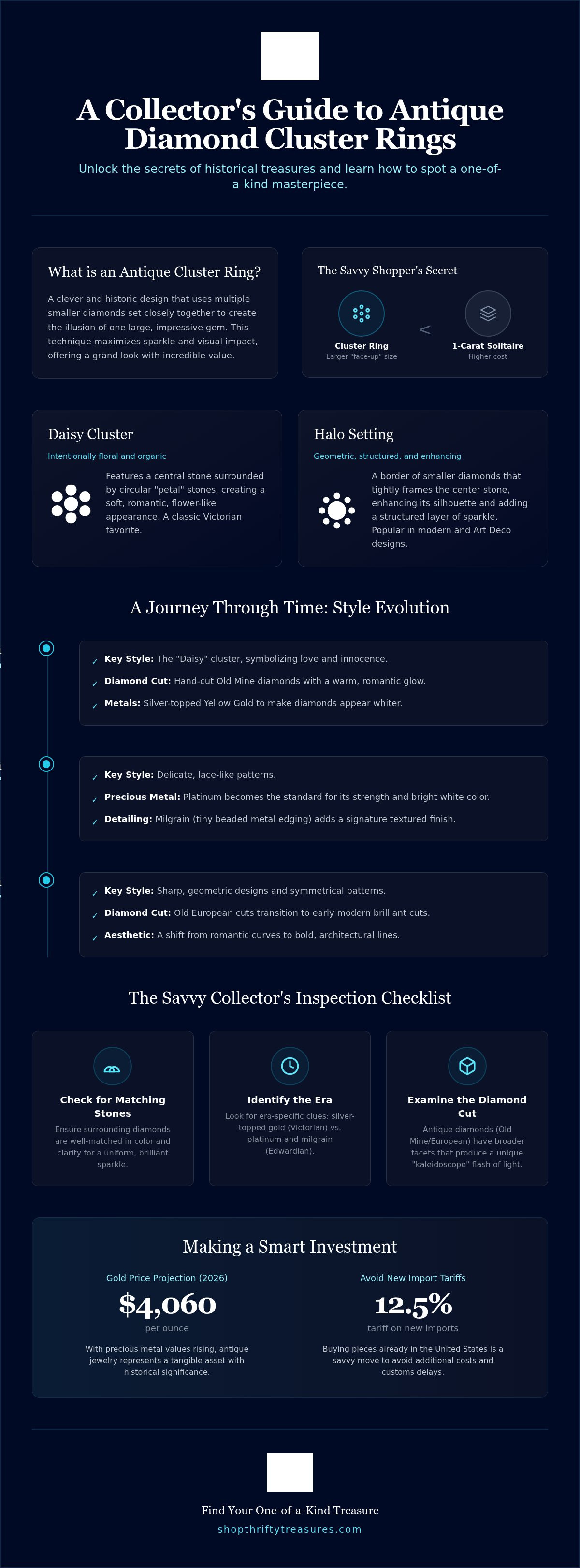
In the world of vintage finds, you'll often hear people talk about "daisy" clusters versus "halo" settings. While they might look similar at a glance, there's a charming distinction. A daisy cluster is intentionally floral, featuring a central stone surrounded by circular "petals" that give it a soft, organic feel. A halo setting is usually more geometric and structured, with a border of diamonds that tightly hugs the center stone to enhance its silhouette. At Shop Thrifty Treasures, we view these pieces as wearable history. Each ring in our curated collection is a vetted survivor that carries the unique fingerprints of the craftsman who built it.
The Anatomy of a Cluster Setting
A classic cluster consists of a "head" where the stones live, usually featuring one slightly larger center diamond surrounded by a ring of "points" or "petals." In older Georgian and Victorian pieces, you'll often find silver-topped gold. Jewelers used silver for the settings because they believed it made the diamonds look whiter, while using gold for the band to ensure strength and durability. Later, during the Edwardian era, platinum became the gold standard for its incredible strength and ability to hold stones in delicate, lace-like patterns. Milgrain is the tiny beaded metal detailing found in cluster borders that gives these antique rings their signature textured, romantic finish.
Why Cluster Rings Are the Savvy Shopper's Secret
If you love a bold look but want to spend wisely, the cluster is your best friend. A cluster of seven 0.10-carat diamonds often has a "face-up" size larger than a single 1-carat solitaire, yet it costs significantly less. This provides incredible hidden value for collectors who want a grand appearance on a real-world budget. The light play is also completely different from modern rings. Because these pieces pre-date modern technology, the evolution of diamond cutting means you're seeing Old Mine or Old European cuts. These stones have broader facets that create a "kaleidoscope" effect, throwing chunky, romantic flashes of light rather than the tiny pinprick sparkles of modern brilliant cuts. It's a sophisticated, soulful look that you simply can't find in a mass-produced modern store.
A Journey Through Time: How Cluster Styles Evolved
The story of the antique diamond cluster ring is a fascinating tale of human ingenuity and changing tastes. Before the mid-19th century, jewelry was almost exclusively the domain of the elite. Each piece was a labor-intensive creation, often featuring diamonds that were salvaged from older settings. As we moved from the Georgian era into the 19th century, the world began to transform. The Industrial Revolution didn't just change factories; it changed the jewelry box. New tools allowed for more precise metalwork, yet the stones themselves remained stubbornly individual. You won't find two identical rings from this period because every diamond was cut by eye and every setting was finished by hand. This one-of-a-kind nature is exactly what makes these historical treasures so rewarding to find.
Victorian Romance and the Rise of the Daisy
Victorians were famously sentimental, and they absolutely loved the "Language of Flowers." This cultural obsession gave birth to the iconic daisy cluster. These rings weren't just pretty; they were secret messages of innocence and loyal love. Most Victorian clusters feature Old Mine Cut diamonds. These are chunky, hand-cut stones with high crowns and small tables that give off a warm, romantic glow. You'll frequently see these diamonds set in silver-topped yellow gold. This was a clever trick of the trade. The silver setting made the diamonds appear whiter and brighter, while the yellow gold band provided the necessary durability for daily wear. If you're looking for a piece with a soulful, organic feel, browsing our collection of vintage rings is a great way to start your own successful mission.
Edwardian Elegance and Art Deco Geometry
As the 1900s arrived, the aesthetic shifted toward a "white on white" look. This era saw the rise of platinum, a metal so strong it allowed jewelers to create settings that looked like frozen lace. Edwardian clusters often used Old European Cut diamonds, which were more circular and symmetrical than their predecessors. This period was all about delicate filigree and ethereal lightness. However, the mood changed again in the 1920s with the arrival of Art Deco. Gone were the soft floral petals; they were replaced by bold, architectural symmetry. This is where the structured "halo" style truly gained momentum. Instead of mimicking a flower, diamonds were arranged in crisp circles or rectangles to emphasize the machine-age geometry. These rings offer a striking, modern presence that still carries the weight of a century-old story.
Identifying the Rare and Unique: From Halos to Kentucky Clusters
Finding a rare antique diamond cluster ring is like uncovering a hidden gem in a crowded market. It's all about the architecture of the piece. When you're browsing, you'll notice two main structural styles: tight and open clusters. A tight cluster features diamonds set so closely together that they share prongs, creating a seamless wall of brilliance. An open cluster, however, leaves breathing room between the stones, allowing the delicate metalwork to shine through. You'll also see many antique halos that incorporate a splash of color. Surrounding a center diamond with a halo of deep blue sapphires or vibrant red rubies was a popular way to add drama and contrast, a look that remains highly collectible in 2026.
What is a Kentucky Cluster Diamond Ring?
If you've ever seen a ring that looks like a miniature sparkling mountain, you've likely found a Kentucky Cluster. This specific regional American style is famous for its tiered, high-domed arrangement. Instead of lying flat against the finger, the diamonds are set at different levels to catch light from every possible angle. It became a staple of American estate jewelry because it offered a bold, expensive look that was hard to ignore. These tiered clusters create a literal staircase of light that draws the eye upward toward the center stone. It's the perfect choice for someone who wants a piece with significant height and presence.
The Enduring Appeal of the Daisy Cluster
The daisy cluster is perhaps the most approachable and beloved style in the world of vintage jewelry. With its central stone and six to ten surrounding "petals," it perfectly captures a sense of timeless charm. It's a versatile choice that bridges the gap between historical elegance and modern casual wear. You can easily pair a daisy ring with a simple white t-shirt and jeans for a touch of everyday luxury, or let it be the star of a formal outfit. Because the design is so recognizable and friendly, it's often the first piece a new collector buys when they start their journey into antique treasures. It's a classic for a reason, offering a soft, feminine silhouette that never goes out of fashion.
The Savvy Collectors Guide: How to Value and Inspect
Becoming a collector is about more than just liking a look; it's about training your eye to see the tiny details that define quality. When you browse for an antique diamond cluster ring, you're looking for a harmonious balance across the entire piece. One of the most critical things to check is how well the stones "match." Because these diamonds were cut by hand over a century ago, they won't be perfectly identical. However, they should share a similar color grade and "fire." If one stone looks drastically whiter or darker than the rest, it might be a later replacement. This doesn't always ruin the value, but it's something a savvy shopper should identify before they commit to a purchase.
Checking the Integrity of the Setting
High-resolution photos are your best friend when shopping online. Look closely at the prongs holding each diamond in place. If the metal looks paper-thin or completely flat, that's a sign of "prong wear." It's a natural result of decades of love, but it means the ring might need a jeweler's touch to stay secure. Loose stones are another common risk in complex cluster arrangements. If you're buying from a distance, don't be afraid to ask the seller if the stones have been tested for "wiggle." Originality adds a massive premium to any find. A ring that still has its original Georgian or Victorian stones is a rare treasure compared to one that's been heavily modified with modern replacements.
Understanding Antique Diamond Cuts
Don't expect the icy, blue-white flash of a modern ring. Antique cuts like the Old Mine, Old European, or the flat-bottomed Rose cut have a much warmer, candlelight glow. These diamonds often have larger facets and a small flat facet at the bottom called a "culet." If you see tiny "imperfections" or slight asymmetries in the shape, celebrate them. These are the hallmarks of a hand-cut gem. They prove the stone isn't a modern, mass-produced imitation. This unique character is exactly what gives an antique diamond cluster ring its soul and historical value.
Use this quick 5-step checklist for your next successful shopping mission:
- Zoom in on the prongs: Ensure they look sturdy enough to hold the gems safely.
- Check stone uniformity: Do the diamonds share a similar "warmth" and cut style?
- Look for hallmarks: Check the inside of the band for stamps indicating gold purity or maker's marks.
- Verify the metal: Confirm if it's the classic silver-topped gold or platinum common for the era.
- Confirm the return policy: Only shop where you have a 30-day window for peace of mind.
Ready to start your hunt? You can explore our vetted collection of vintage rings to find a one-of-a-kind piece that passes every inspection with flying colors.
Finding Your Treasure at Shop Thrifty Treasures
Finding that perfect antique diamond cluster ring shouldn't feel like a high-pressure sales meeting. At Shop Thrifty Treasures, we believe the experience should feel like a successful mission shared between friends. We aren't a faceless corporate giant; we're a boutique that celebrates the thrill of the find just as much as you do. Our philosophy is simple: we provide an accessible, curated path to owning a piece of history. We treat every customer like a savvy peer because we know you value quality and smart spending just as much as we do. When you finally secure that one special antique diamond cluster ring you've been eyeing, the feeling of satisfaction is unbeatable.
Curated for Craftsmanship and Value
Every single piece in our collection undergoes a rigorous vetting process. We look for excellence in craftsmanship that has stood the test of time. You won't find mass-produced, cookie-cutter designs here. Instead, you'll discover one-of-a-kind treasures that tell a unique story from the Victorian, Edwardian, or Art Deco eras. By focusing on hand-selected items, we ensure that the "hidden value" we discussed earlier is present in every ring we offer. We take pride in being your resourceful guide, helping you spot the opportunities that others might miss in a crowded marketplace. Join our community of treasure hunters who know that the best jewelry isn't found at a local mall, but in the carefully guarded collections of experts who care about the narrative behind the sparkle.
Reliable Shipping and Easy Returns
We understand that buying high-value jewelry online can feel a bit daunting. That's why we've built a shipping and return process designed for your total peace of mind. We offer secure national shipping across the United States, ensuring your new heirloom arrives safely at your door without the hassle of international customs. Because it's 2026 and we value your trust above all else, we provide a 30-day return policy on every purchase. If the light play isn't exactly what you imagined when you see it in person, or if the fit isn't quite right, sending it back is simple and stress-free. This safety net allows you to shop with confidence, knowing your investment is protected from the moment you click "buy" until the piece is safely on your finger.
Browse our curated collection of vintage rings for sale today!
Start Your Own Sparkling Chapter
You've journeyed through the romantic floral motifs of the Victorian era and seen how the bold, architectural lines of Art Deco redefined the antique diamond cluster ring. By now, you're equipped with the insider knowledge to spot a genuine "staircase of light" in a Kentucky Cluster and identify the warm, soulful glow of an Old Mine cut. You know that checking for prong wear and matching stones isn't just about technicalities; it's about ensuring your treasure lasts for another century. Choosing a piece of history should be a rewarding mission, not a stressful gamble.
At Shop Thrifty Treasures, we've already done the heavy lifting for you. Each piece is hand-vetted for quality and value, so you can focus on finding the design that speaks to your heart. With our 30-day satisfaction guarantee and secure national shipping across the United States, you can explore our collection with total peace of mind. Your perfect heirloom is waiting to be rediscovered. Discover Your One-of-a-Kind Antique Diamond Cluster Ring and bring home a piece of wearable history today. Happy hunting!
Expert Answers for Savvy Collectors
How can I tell if a diamond cluster ring is a true antique?
Look for hallmarks inside the band and the specific cut of the stones. True antiques often feature Old Mine or Old European cuts with high crowns and small tables. You should also check for silver-topped gold settings, which were common before platinum became the standard. A genuine antique diamond cluster ring will show slight hand-crafted asymmetries that modern, laser-cut reproductions simply can't replicate. These tiny details prove the piece was made by hand.
Are antique diamond cluster rings safe for everyday wear as engagement rings?
Yes, they are generally safe, but they require a bit more care than modern mass-produced bands. Most antique clusters were built to last lifetimes, but you should have a jeweler check the prongs once a year. Since these rings often use durable gold or platinum, they are sturdy enough for daily life. Just remember to remove them before heavy lifting or using harsh chemicals to keep that historical sparkle intact for another century.
What is the difference between an antique halo and a daisy cluster?
The main difference lies in the arrangement and the mood of the piece. A daisy cluster is intentionally floral, with "petals" of diamonds surrounding a center stone to create a soft, organic flower shape. An antique halo is more structured and geometric, featuring a tight circle or rectangle of diamonds that "hugs" the center gem. While both maximize light, the daisy feels romantic and Victorian, whereas the halo often feels more architectural and modern.
Can an antique cluster ring be resized without damaging the setting?
Most antique rings can be resized by a skilled jeweler, but there are limits. If the band has elaborate engraving or filigree that goes all the way around, resizing might disrupt the pattern. It's usually easier to go up or down one or two sizes. Always ask for a non-destructive assessment first. Since these are one-of-a-kind treasures, preserving the integrity of the original metalwork is the top priority for any savvy shopper.
Why do antique diamonds look different than modern ones?
It's all about how they were cut. Before modern lasers, diamonds were hand-cut to sparkle under candlelight. This resulted in broader facets and a "warmer" glow compared to the sharp, icy brilliance of modern stones. You'll notice chunky flashes of light instead of tiny pinpricks. These unique characteristics are signs of authenticity that tell the story of the craftsman's hand, making every antique diamond cluster ring a unique masterpiece with its own soul.
What should I look for when buying an antique ring online?
Focus on high-resolution photos and clear seller policies. You want to see the prongs from multiple angles to check for wear and ensure no stones are loose. Verify that the seller has a solid return policy, like our 30-day guarantee, so you can inspect the piece in person. In 2026, it's also smart to buy domestically to avoid the new 12.5% import tariffs on jewelry coming from countries like Canada or the United Kingdom.
What is a Kentucky cluster diamond ring and why is it special?
A Kentucky cluster is a uniquely American estate style known for its tiered, high-domed design. Instead of a flat surface, the diamonds are arranged in levels, creating a "staircase of light" that adds incredible height and presence to your finger. It's special because it maximizes the visual impact of smaller diamonds. This gives you a grand, opulent look that's much more affordable than a single large solitaire of the same total carat weight.
Does Shop Thrifty Treasures offer a return policy on antique jewelry?
Absolutely. We offer a 30-day return policy for peace of mind on every single item in our collection. We want you to feel like a savvy insider, not a worried shopper. If your new find doesn't spark joy the moment you open the box, you can return it easily. This safety net, combined with our secure national shipping across the United States, makes your mission for a hidden treasure completely stress-free.